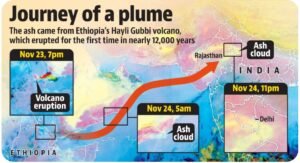
Current Affairs | Geography Ethiopia’s Hayli Gubbi Volcano Ash Cloud Reaches India 1) What Happened? (Event Overview) Ethiopia’s Hayli Gubbi volcano erupted after nearly 10,000 years. Ash cloud entered India on Monday evening, first hitting Gujarat, then Rajasthan, NW Maharashtra, Delhi, Haryana, Punjab. Ash plume is moving towards the Himalayas at 100–120 km/hr. Volcano lies in the Afar Rift Valley, a highly active tectonic zone. 2) Ash Cloud Features Ash height: 15,000–25,000 ft (some layers touched 45,000 ft). Contents: Volcanic ash, sulphur dioxide (SO₂), tiny particles of glass and rock. Skies may appear darker, hazier, visibility may dip. Chances of ashfall on plains: Low. 3) Impact on Indian Cities Affected regions: Gujarat, Rajasthan, Delhi-NCR, Haryana, Punjab, NW Maharashtra. Plume already above Delhi and Western UP late Monday night. Expected to influence Himalayan areas and Nepal hills (SO₂ increase). 4) Will AQI Worsen? (Safety Update) NO major impact on India’s ground-level AQI. Reason: Ash is at high altitude (25,000–45,000 ft). Only sky darkening and haziness possible. Some SO₂ may affect Himalayan–Nepal hills & UP Terai region. 5) How Did the Ash Travel? Eruption began: Sunday, 8:30 am GMT (VAAC, Toulouse). Ash rose 14 km high, then drifted over:Red Sea → Yemen → Oman → Arabian Sea → India → Pakistan. 6) Aviation Impact Airlines issued warnings due to ash in Middle East airspace. DGCA advisory: Avoid ash-affected routes. Adjust flight plans & fuel load. Inspect runways if ash is suspected. Flight disruptions: Akasa, IndiGo, KLM cancelled some flights. Mumbai Airport alerted passengers of route impacts. PrevSupreme Court Clarifies Governor’s Powers on State Bills & Legislative AssentNextAIDS and TB Fight — Tamil Nadu Shows the Way Again Related Posts India’s Progress in Securing LGBTQIA+ & Transgender Rights: A Comprehensive OverviewRead More Supreme Court Clarifies Governor’s Powers on State Bills & Legislative AssentRead More AIDS and TB Fight — Tamil Nadu Shows the Way AgainRead More
 Current Affairs | Geography




 own.sseduspace@gmail.comCurrent Affairs | Geography